
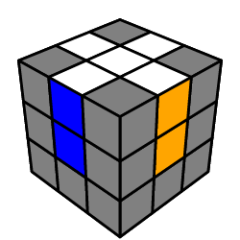
The crossNew
The four edges of the first face, placed without undoing the ones you already have.
8 casesFridrich method (CFOP)
All 119 cases of full CFOP, each with its 3D preview. Scan your cube with the camera, learn notation by playing and compete in the global rankings.
The method, in four steps
CFOP, also called the Fridrich method, is what almost every speedcuber uses. The app follows its four stages and gives you every case with its picture, its standard notation and its 3D preview.
The four edges of the first face, placed without undoing the ones you already have.
8 cases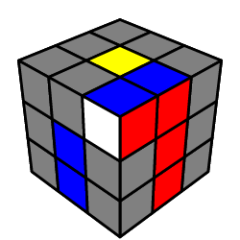
Each corner with its edge, in a single insert. This is where most of the time is won.
41 cases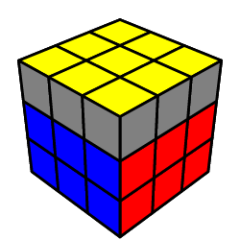
The whole top face in one colour, with a single algorithm.
57 cases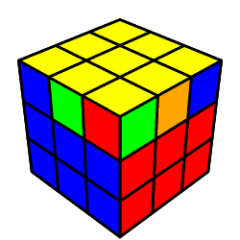
Every piece in its place, and the cube is solved.
21 casesWhat the app does
Find the case, watch it in 3D move by move and, once you know it, mark it as done.
Show each face to the camera and the app recognises your cube. If a sticker is misread, fix it with one tap. Then it shows you the solution in 3D, with your own cube's colours.
The reduced view keeps only the essentials: the 16 2-Look algorithms (10 OLL and 6 PLL), which are enough to finish the cube, and the most basic F2L cases. The problem with CFOP is not difficulty, it is volume.
T-Perm · PLL
With Google Play Games. You can also play without signing in; your records stay on your phone.
History, statistics and your personal best, on your phone.
Favourites, completed cases and a backup whenever you want.
The app is free with ads. Premium is paid once and it is yours for good.
FAQ
It is the most widely used way to solve the 3x3 cube fast. The name is the initials of its four stages: Cross, F2L (first two layers), OLL (orient the last layer) and PLL (permute it). It was developed in parallel between the late seventies and early eighties by Jessica Fridrich and Mirek Goljan on one side and Hans Dockhorn and Anneke Treep on the other. Fridrich published it online in 1997, hence the name.
It helps. CFOP is the next step after the layer-by-layer method in beginner tutorials: the cross is the same, but the first two layers go in as corner-and-edge pairs, and the last layer takes fewer steps.
No, and it is not the way to start. The cross and F2L can be done intuitively, and the last layer can be solved in two steps per stage (2-Look) with just 16 algorithms: 10 for OLL and 6 for PLL. Those 16 are enough to go under 20 seconds. The full method is 78 last-layer algorithms (57 OLL and 21 PLL), plus the 41 F2L cases.
First the cross and F2L, intuitively. Then 2-Look OLL and 2-Look PLL. Once you are under 25 seconds, move to the full method; most people finish the 21 PLLs, which are fewer, before the 57 OLLs.
Each letter is a face: R right, L left, U up, D down, F front and B back. On its own, turn it a quarter clockwise as you look at that face; with an apostrophe (R'), the other way; with a 2 (R2), a half turn. A w or a lowercase letter (Rw, r) moves two layers, M, E and S move the middle slices, and x, y, z turn the whole cube.
Because that way the first two layers go in without turning the cube over, and you can see them as you work. Any cross can be solved in 8 moves or fewer, and with practice the average drops to about 6, so you can plan all of it during the 15-second inspection.
It is almost always the pauses, not your hands. The key is lookahead: while you execute one F2L pair, you are already hunting for the next. Turn slower than you can and without stopping: more time is won by looking than by moving.
The app is free, with ads. Premium is a one-time purchase, no subscription, and adds three things: guided CFOP solving on your scanned cube, unlimited custom algorithms, and no ads anywhere in the app.
Because all 119 are there (41 F2L, 57 OLL and 21 PLL), plus 9 alternative algorithms for cases many people find easier another way, for example with the other hand or from another angle. In the app, each alternative says which case it belongs to.
A button that keeps only the essentials in each list: the 16 2-Look algorithms, which are enough to finish the cube from start to end, and the most basic F2L cases. The same button takes you back to the full method.
The app tells you how to turn the cube to show each face to the camera. In low light you can switch on the torch, and any sticker it is not sure about is marked so you can confirm it or fix it with one tap. You can also paint the cube by hand. Then it works out the shortest solution and shows it in 3D; with Premium it also guides you stage by stage through CFOP.
Yes. When you type an algorithm in full without mistakes in Sequences, Practice mode, it moves to Today's review: it comes back just when it is worth recalling, with more days in between each time. It is mastered once you remember it after a week without seeing it, and a mistake sends it back to the start.
With your Google Play Games account. The modes with a trophy count, the timed Quiz and endless Sequences, each level on its own, with three lives and daily, weekly and all-time rankings. Every game is verified. Without signing in you can still play, and your records stay on your phone.
It works offline and without an account; only the rankings need a connection. To change phones, export a backup: a .cfop file with your favourites, completed cases, times, quiz records and custom algorithms, which you then import on the new one.
For now it is on Google Play for Android; the iPhone version will come to the App Store later. It is in 10 languages: English, Spanish, French, German, Italian, Portuguese, Japanese, Korean, Chinese and Indonesian.
That is how the 119 get done.